
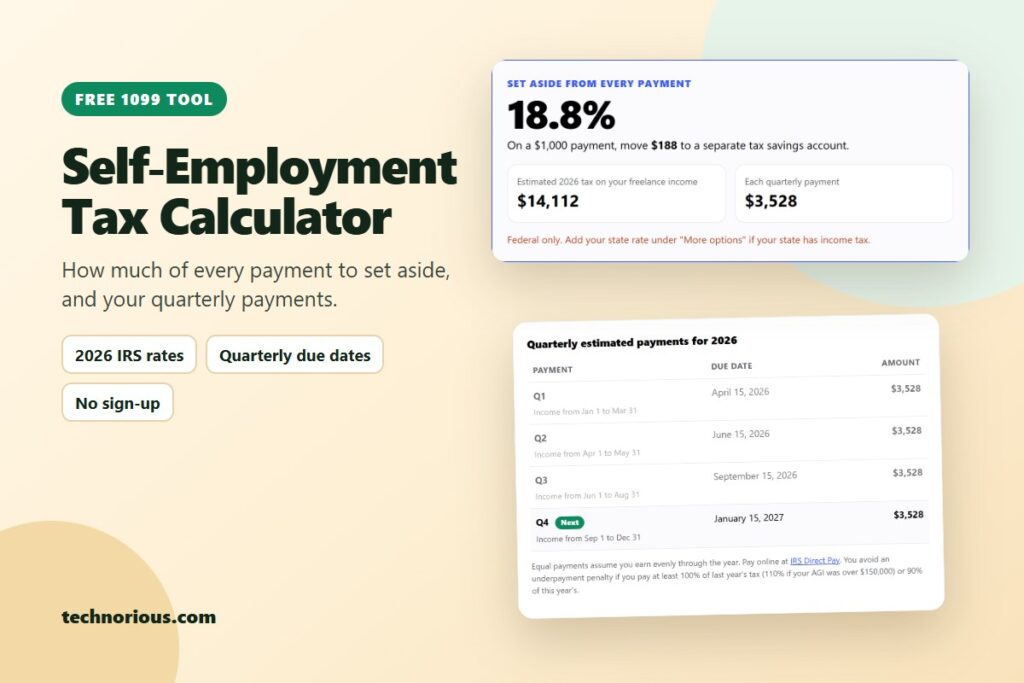
Quick answer: In 2026, self-employment tax is 15.3% (12.4% Social Security plus 2.9% Medicare) on 92.35% of your net profit, which works out to about 14.1% of profit. Federal income tax comes on top. For most single freelancers earning $40,000 to $100,000, the total federal tax is roughly 19% to 23% of what they earn, so setting aside 20% to 25% of every payment, plus your state’s income tax, is a safe habit. Enter your numbers above for your own figure.
How to calculate your self-employment tax in 5 steps
- Pick your filing status. Single, married filing jointly, head of household or married filing separately. It sets your standard deduction and tax brackets.
- Enter your freelance income for the year. Add up everything clients and platforms paid you, or your best estimate for the full year. Include income with or without a 1099 form: all of it is taxable.
- Enter your business expenses. Software, equipment, platform fees, part of your internet and phone, and other costs of doing the work. Your profit (income minus expenses) is what gets taxed.
- Add a job or your state, if they apply. Under “More options”, add W-2 wages if you also have a job, and your state’s income tax rate. Wages can push your freelance income into a higher bracket and use up part of the Social Security limit.
- Read your set-aside percentage and quarterly payments. Move that percentage of every payment into a separate savings account, and pay the quarterly amount to the IRS by each due date.
2026 self-employment tax rates and limits
| Part | Rate | What it applies to in 2026 |
|---|---|---|
| Social Security | 12.4% | The first $184,500 of combined wages and self-employment earnings |
| Medicare | 2.9% | All self-employment earnings, no limit |
| Additional Medicare | 0.9% | Earnings above $200,000 (single and head of household), $250,000 (married filing jointly) or $125,000 (married filing separately) |
| Earnings that count | 92.35% | Self-employment tax is charged on 92.35% of your net profit, not all of it |
| Minimum | $400 | No self-employment tax if those net earnings are under $400 |
| Deduction | 50% | You deduct half of your self-employment tax when you work out income tax |
How much to set aside for taxes on 1099 income
These are federal estimates from the calculator for 2026, with no other income, the standard deduction and the QBI deduction. Add your state’s income tax rate on top.
| Net profit | Single: total federal tax | Single: set aside | Married filing jointly: set aside |
|---|---|---|---|
| $20,000 | $3,025 | 15% | 14% |
| $40,000 | $7,427 | 19% | 15% |
| $60,000 | $12,037 | 20% | 17% |
| $80,000 | $16,647 | 21% | 19% |
| $100,000 | $22,365 | 22% | 20% |
| $150,000 | $37,608 | 25% | 21% |
If you also have a job, your freelance income is taxed at your higher brackets, so the right percentage is usually higher. Use “More options” in the calculator to add your wages.
2026 federal income tax brackets
| Rate | Single (taxable income) | Married filing jointly | Head of household |
|---|---|---|---|
| 10% | Up to $12,400 | Up to $24,800 | Up to $17,700 |
| 12% | $12,401 to $50,400 | $24,801 to $100,800 | $17,701 to $67,450 |
| 22% | $50,401 to $105,700 | $100,801 to $211,400 | $67,451 to $105,700 |
| 24% | $105,701 to $201,775 | $211,401 to $403,550 | $105,701 to $201,750 |
| 32% | $201,776 to $256,225 | $403,551 to $512,450 | $201,751 to $256,200 |
| 35% | $256,226 to $640,600 | $512,451 to $768,700 | $256,201 to $640,600 |
| 37% | Over $640,600 | Over $768,700 | Over $640,600 |
The 2026 standard deduction is $16,100 for single filers and married filing separately, $32,200 for married filing jointly and $24,150 for heads of household.
Quarterly estimated tax due dates for 2026
| Payment | For income earned | Due date |
|---|---|---|
| 1st | January 1 to March 31 | April 15, 2026 |
| 2nd | April 1 to May 31 | June 15, 2026 |
| 3rd | June 1 to August 31 | September 15, 2026 |
| 4th | September 1 to December 31 | January 15, 2027 |
You generally have to pay estimated tax if you expect to owe $1,000 or more when you file. You avoid the underpayment penalty if your payments cover at least 90% of this year’s tax or 100% of last year’s tax (110% if last year’s adjusted gross income was over $150,000).
Expenses that lower your self-employment tax
Self-employment tax is charged on profit, so every legitimate business expense lowers both your self-employment tax and your income tax. Common ones for freelancers:
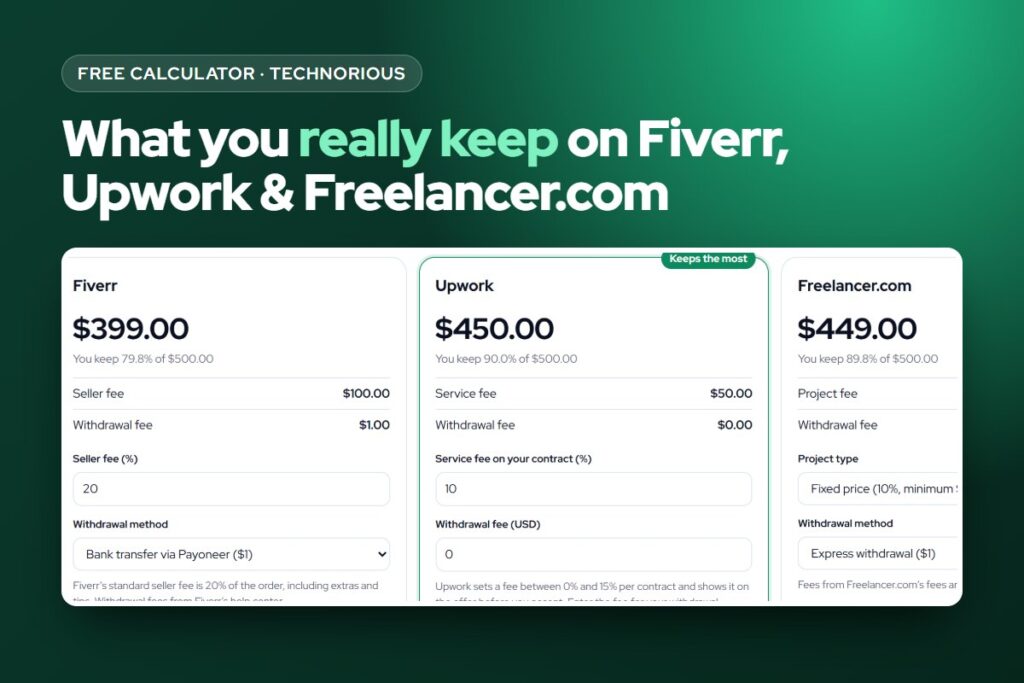
- Platform and payment fees: the service fees Upwork and Fiverr keep, plus PayPal, Payoneer or bank fees. Our freelance fee calculator shows how much they take.
- Software and subscriptions you use for client work, such as design tools, hosting and accounting apps.
- Equipment: a laptop, monitor or camera used for the business.
- Home office: a space used regularly and only for work. The simplified method allows $5 per square foot, up to 300 square feet.
- Internet and phone: the business-use share of the bill.
- Courses and books that keep up or improve skills for your current work.
Two deductions lower income tax but not self-employment tax: self-employed health insurance premiums and contributions to a SEP IRA or solo 401(k). They are worth claiming, but they don’t change the 15.3% part.
This calculator gives an estimate for US federal taxes for tax year 2026, using IRS figures checked on 21 November 2026. It assumes the standard deduction, no tax credits and that tax on any W-2 wages is withheld by your employer. It is general information, not tax advice. For your exact situation, use IRS Form 1040-ES or ask a tax professional.
Frequently asked questions
How much is self-employment tax in 2026?
Self-employment tax is 15.3% on 92.35% of your net profit: 12.4% for Social Security on the first $184,500 of earnings and 2.9% for Medicare on all of it. On $60,000 of profit that is $8,478. Income tax is charged separately on top.
How much should I set aside for taxes on 1099 income?
Most single freelancers earning $40,000 to $100,000 owe about 19% to 23% of their income in federal tax, so setting aside 20% to 25% of every payment, plus your state income tax rate, is a safe rule. If you also have a full-time job, set aside more, because your freelance income is taxed at your higher bracket.
Do I have to pay self-employment tax if I earn less than $400?
No. If your net earnings from self-employment (92.35% of your profit) are under $400 for the year, you don’t owe self-employment tax. You may still need to report the income for income tax.
Is self-employment tax the same as income tax?
No. Self-employment tax is the Social Security and Medicare tax that an employer would normally split with you. Income tax is separate and depends on your brackets and deductions. Freelancers pay both, and half of the self-employment tax is deductible when you work out income tax.
When are quarterly estimated taxes due in 2026?
The 2026 due dates are April 15, June 15 and September 15, 2026, and January 15, 2027. You can pay online with IRS Direct Pay or through your IRS online account.
Do I need a 1099 form to pay tax on freelance income?
No. All freelance income is taxable, whether or not a client or platform sends you a Form 1099-NEC or 1099-K. Keep your own record of every payment.
What is the QBI deduction?
The qualified business income deduction lets many freelancers deduct up to 20% of their business profit, after the deduction for half of self-employment tax, when working out income tax. It phases out for higher incomes, starting at $201,750 of taxable income for single filers in 2026. It does not reduce self-employment tax.
Does the calculator include state taxes?
Only if you add a rate. Open “More options” and enter your state’s income tax rate as a percentage. States such as Texas and Florida have no state income tax, so leave it at 0 there.
Sources
- IRS Topic 554: Self-employment tax
- IRS: Self-employment tax (Social Security and Medicare taxes)
- Social Security Administration: 2026 contribution and benefit base ($184,500)
- IRS Revenue Procedure 2025-32: 2026 tax brackets, standard deduction and QBI thresholds
- IRS Topic 560: Additional Medicare tax
- IRS Form 1040-ES: Estimated tax for individuals (2026)