
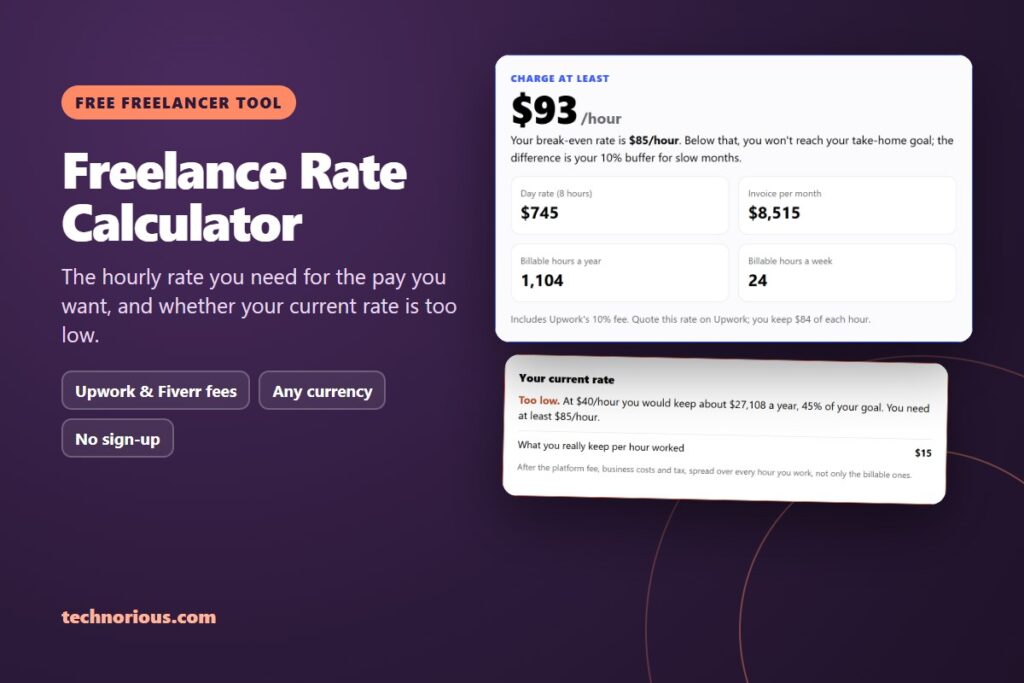
Quick answer: To find your freelance hourly rate, add the take-home pay you want, your business costs and the tax you will owe, then divide by the hours a client actually pays for, not every hour you work. If you get clients through Upwork or Fiverr, divide again by what’s left after their fee. For example, to take home $5,000 a month working 40 hours a week with 60% of that time billable, you need about $84 an hour from direct clients, $93 on Upwork at a 10% fee and $105 on Fiverr. Enter your own numbers above.
How to calculate your freelance rate in 5 steps
- Enter the take-home pay you want. This is what you want to keep after tax and costs, per month or per year, in your own currency. Think of it as the salary you are paying yourself.
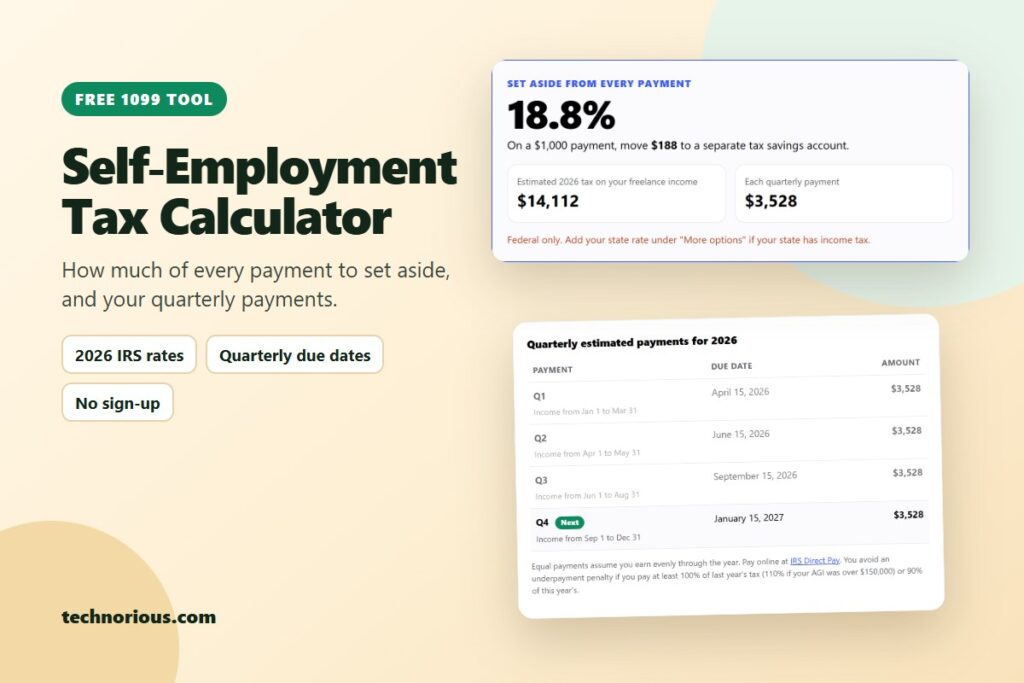
- Check your costs and tax. The calculator starts with $300 a month in business costs and 25% set aside for tax. Open “Adjust assumptions” to change them: software, internet, equipment and health insurance come out of what you charge, and so does tax. US freelancers can get an exact tax figure from our self-employment tax calculator.
- Pick where clients pay you. Direct clients cost nothing extra. Fiverr keeps 20%, and Upwork keeps 0% to 15% depending on the contract. The calculator raises your rate so the fee comes out of the client’s side, not your pay.
- Be honest about billable hours. Set your hours a week, then, under “Adjust assumptions”, the share a client actually pays for (60% to start) and the weeks you will take off (6 to start). Finding clients, messages, invoicing and unpaid revisions are real work, but nobody pays for them.
- Check your current rate. Type the rate you charge today to see what you really keep for every hour you work, and whether it reaches your goal. Then use the project box to turn your rate into a fixed-price quote.
Freelance hourly rates for common take-home goals
Calculated with the tool: $300 a month in business costs, 25% set aside for tax, 40 hours a week with 60% billable, 6 weeks off and a 10% buffer for slow months. The break-even rate (no buffer) is in brackets.
| Take-home pay | Direct clients | Upwork (10% fee) | Fiverr (20% fee) |
|---|---|---|---|
| $2,000 a month | $36 ($33) | $40 ($36) | $45 ($41) |
| $3,000 a month | $52 ($47) | $58 ($52) | $65 ($59) |
| $5,000 a month | $84 ($76) | $93 ($85) | $105 ($95) |
| $8,000 a month | $135 ($120) | $150 ($135) | $165 ($150) |
These rates are higher than many people expect, and that’s the point. A $5,000 month needs about $92,000 billed in a year once costs, tax and a buffer are included, and only about 1,100 of your 1,840 working hours are paid.
Why billable hours change your rate the most
Most new freelancers divide their income goal by 40 hours a week and 52 weeks. That assumes every hour is paid and you never take a day off. Here is the same $5,000 a month goal from direct clients at different billable shares:
| Share of time billable | Paid hours a year | Rate you need |
|---|---|---|
| 40% (new freelancer, still finding clients) | 736 | $125 |
| 50% | 920 | $100 |
| 60% (a common planning figure) | 1,104 | $84 |
| 70% | 1,288 | $72 |
| 80% (steady repeat clients) | 1,472 | $63 |
Repeat clients raise your billable share, because you spend less time finding work. That is why a freelancer with regular clients can charge less per hour and still earn more.
Is my rate too low? Signs to look for
- You are always busy but never ahead. If you are fully booked and still short of your goal, the rate is the problem, not the workload.
- Clients accept every quote straight away. No pushback at all usually means you are below what the market will pay.
- You forgot the platform fee. At $25 an hour on Upwork with a 10% fee, you keep $22.50 before costs and tax. Our freelance fee calculator shows the exact amount after withdrawal fees too.
- What you keep per hour worked is low. In the example above, $25 an hour on Upwork leaves about $8.70 for every hour you work once unpaid time, costs and tax are counted. The “Check your current rate” box shows your own figure.
- You haven’t raised it in a year. Your costs went up; your rate should too. A small increase for new clients is the safest way to test it.
From experience: My first freelance rate was too low, and I had to raise it later. Today I charge between $20 and $40 an hour for web development. Upwork is still my best source of clients, and my direct clients pay 50% upfront before I start.
Hassan Saleem, founder of Technorious
Turning your hourly rate into a project price
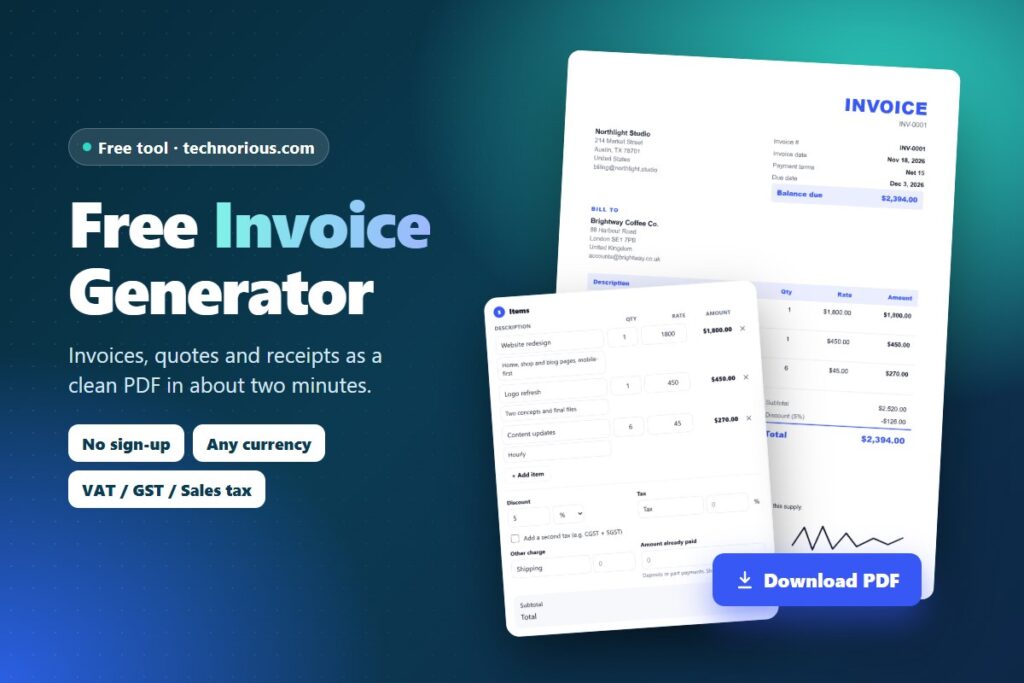
Clients often prefer a fixed price. Estimate the hours, multiply by your rate, then add about 20% for revisions and surprises, because most projects take longer than the first estimate. At $93 an hour, a 12-hour job is $1,116, or $1,340 with the buffer. Write down what is included and how many revision rounds, then send the quote or invoice with our free invoice generator. For the full method with more examples, read our guide to pricing freelance work with a simple hourly rate formula.
This calculator gives an estimate for planning. The tax percentage is a set-aside you choose, not a calculation of the tax you will owe; that depends on your country, income and deductions. Fiverr’s 20% fee and Upwork’s 0% to 15% range were checked on 24 November 2026. Nothing you enter leaves your browser.
Frequently asked questions
How do I calculate my freelance hourly rate?
Add the take-home pay you want for a year, your yearly business costs and the tax you will owe on that profit. Divide the total by your billable hours: weeks worked times hours a week times the share of time a client pays for. If a platform takes a fee, divide the result by one minus the fee, for example by 0.9 for a 10% fee.
What should I charge as a beginner freelancer?
Start from the rate the calculator gives you, not from the lowest rate you can find on Upwork or Fiverr. If you need a few cheaper jobs to get your first reviews, treat it as a short trial with an end date, and raise your rate for new clients once you have reviews and samples.
How many hours a week can a freelancer bill?
Fewer than you work. Many freelancers plan on 50% to 70% of their working time being billable, because finding clients, admin and revisions take the rest. New freelancers are often below 50% until they have repeat clients.
Should I charge more on Upwork or Fiverr than to direct clients?
Your rate on a platform needs to cover its fee. Fiverr keeps 20% of each order, so to keep the same $84 an hour you would charge about $105. Upwork’s fee is 0% to 15% per contract and is shown on the offer before you accept, so enter yours in the Fee box.
What is a day rate, and how is it calculated?
A day rate is your hourly rate times the hours in a working day, usually 8. The calculator shows it next to your hourly rate. Day rates suit work where hours are hard to predict, such as on-site or consulting days.
Does the calculator work in my currency?
Yes. Choose your currency and enter amounts in it; nothing is converted. If you earn in US dollars but spend in another currency, enter your goal and costs in dollars at today’s exchange rate.