

A quote offers a price, a proforma invoice confirms the price and asks for payment before the work or goods are supplied, and an invoice is the final bill for a supply that has happened or been agreed. Only the final invoice, or tax invoice, is a demand for payment that counts for tax: in the UK, HMRC says a proforma cannot be used to reclaim VAT and should be marked “this is not a VAT invoice”. This guide compares the three documents side by side, shows an example of each, and explains when exporters need a proforma or a commercial invoice. You can create any of them with our free Invoice Generator.
Proforma invoice vs invoice vs quote: the differences
| Quote (or estimate) | Proforma invoice | Invoice (tax invoice) | |
|---|---|---|---|
| Purpose | Offer a price for work or goods | Confirm the deal and request payment in advance, or describe a shipment | Bill the customer for what was supplied |
| When it is sent | Before the customer decides | After the customer agrees, before supply | When or after the work or goods are delivered |
| Is it a demand for payment? | No | A request for advance payment, not a final bill | Yes |
| Counts for tax or VAT? | No | No; it cannot be used to reclaim VAT | Yes, if it shows the required tax details |
| Recorded as a sale? | No | No | Yes |
| Can it change? | Yes, until accepted | Yes; the final invoice may differ | Corrected only with a credit note |
| Typical label | Quote, Quotation, Estimate | Proforma Invoice, “This is not a tax invoice” | Invoice, Tax Invoice, VAT Invoice |
| Numbering | Own series, e.g. QUO-031 | Own series, e.g. PRO-012 | Sequential invoice series, e.g. INV-2026-014 |
What is a quote?
A quote is a written price offer. It tells the customer what you will do or supply, how much it will cost and how long the price is valid. It is not a bill and creates no obligation to pay until the customer accepts it. An estimate is similar but signals that the final price may change, while a quote usually fixes the price for the scope described.
| Quote QUO-031 · Date 3 Nov 2026 · Valid until 17 Nov 2026 | Amount |
|---|---|
| Brand identity package: logo, colour palette, 2 revision rounds | $900.00 |
| Social media templates (10 designs) | $300.00 |
| Quote total | $1,200.00 |
| Terms if accepted: 50% deposit before work starts, balance Net 15. | |
What is a proforma invoice?
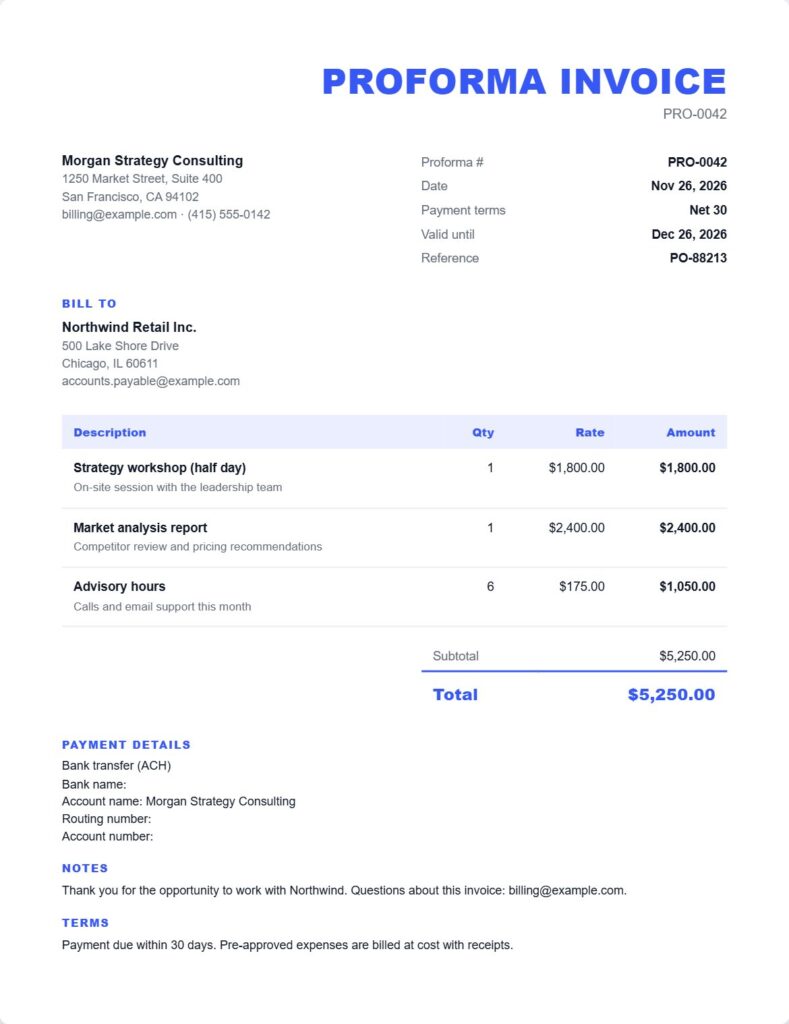
A proforma invoice is a preliminary bill sent before the goods or services are supplied. It looks like an invoice, with the seller, buyer, items, prices and total, but it is a commitment and a payment request rather than a final bill. Businesses use proformas to collect payment in advance, to let a buyer arrange funds or an import licence, and to describe a shipment before the final commercial invoice exists.
Because a proforma is not a tax document, it should say so. HMRC’s VAT Notice 700 (section 17.3) explains that proforma invoices cannot be used as evidence to reclaim input tax, even if they show all the details of a VAT invoice, and should be clearly marked “this is not a VAT invoice”. Once you are paid and supply the work, issue a proper invoice.
| Proforma Invoice PRO-012 · Date 6 Nov 2026 · Valid until 20 Nov 2026 | Amount |
|---|---|
| Brand identity package: logo, colour palette, 2 revision rounds | $900.00 |
| Social media templates (10 designs) | $300.00 |
| Total | $1,200.00 |
| Deposit due now (50%) | $600.00 |
| This is not a tax invoice. A final invoice will be issued on completion. | |
What is an invoice?
An invoice is the final, numbered bill for goods or services supplied. It records the sale for both sides, starts the payment terms and, when it includes the required tax details, is the document the customer uses to claim back tax. A tax or VAT invoice must follow the rules of the country where you are registered; in the UK that means a sequential number, the tax point, your VAT number and the VAT charged, among other details. If the invoice is wrong, you issue a credit note and a new invoice rather than editing it.
| Invoice INV-2026-019 · Date 28 Nov 2026 · Due 13 Dec 2026 (Net 15) | Amount |
|---|---|
| Brand identity package: logo, colour palette, 2 revision rounds | $900.00 |
| Social media templates (10 designs) | $300.00 |
| Subtotal | $1,200.00 |
| Less deposit received 7 Nov 2026 (ref. PRO-012) | −$600.00 |
| Balance due | $600.00 |
The three examples follow one project from offer to final bill. The quote and proforma never count as sales; the invoice does, and it references the deposit already paid so the customer’s accounts team can match everything. For a full walkthrough of the final document, see how to write a freelance invoice, which includes a complete filled-in example.
Proforma invoice vs commercial invoice
In international trade, a commercial invoice is the final invoice for exported goods, and customs uses it to check what is being imported and to calculate duty. A proforma invoice is sent earlier, to agree terms and arrange payment, and is used at customs only as a substitute when the commercial invoice is not yet available.
US rules show the difference clearly. Under 19 CFR 141.86, each commercial invoice for imported goods must include details such as the port of entry, a detailed description of the merchandise and the purchase price of each item. Where the required invoice is not available, 19 CFR 141.85 sets out the form of the pro forma invoice that can be filed instead, under the conditions in 19 CFR 141.91.
| Proforma invoice | Commercial invoice | |
|---|---|---|
| Timing | Before shipment | At or after shipment |
| Main use | Agree price and terms, request advance payment, apply for import licences or financing | Customs clearance, duty calculation, payment |
| Binding? | No; details may change | Yes; it is the final bill |
| Used by customs? | Only as a temporary substitute | Yes |
When exporters need a proforma invoice
Exporters send a proforma when the buyer needs a formal document before money moves. Common cases:
- Advance payment: the buyer’s bank needs a proforma to send payment before shipment.
- Letters of credit: the proforma sets out the goods, prices and terms that the letter of credit will reflect.
- Import permits and foreign exchange: in some countries the importer must show a proforma to get a licence or buy foreign currency.
- Customs estimates: the buyer can work out duties and taxes before agreeing to the order.
Exporters in Pakistan follow the same pattern: banks and buyers often ask for a proforma to arrange an advance payment or a letter of credit, and the final commercial invoice goes with the shipment and the customs declaration. Requirements change, so confirm the documents your bank, buyer and Pakistan Customs need for each shipment.
Do freelancers and service businesses need proforma invoices?
Sometimes. If you ask for a deposit before starting, a proforma is a clean way to request it: the client gets a document their finance team can approve, and you avoid recording a sale before any work is done. Some corporate and government clients also need a proforma before they can raise a purchase order. Once the work is done, send the final invoice, show the deposit already paid and bill the balance with clear terms, such as those explained in our guide to Net 30 payment terms.
If you work through Fiverr or Upwork, you usually do not need any of these documents for the client: the platform takes payment and issues its own records. See our guides to Fiverr fees and Upwork fees.
What to include on a proforma invoice
- The title “Proforma Invoice” and a proforma number from its own series
- Issue date and the date until which the offer is valid
- Seller and buyer names, addresses and contact details
- Description, quantity, unit price and amount for each item
- Estimated taxes, shipping and other charges, if known
- Total, currency and the amount requested now (full or deposit)
- Payment terms and bank or payment details
- For goods: estimated shipping date, weight, origin and delivery terms such as Incoterms
- The note “This is not a tax invoice”
Which document should you send? A quick decision guide
| Your situation | Send |
|---|---|
| A prospect asks “how much would this cost?” | Quote or estimate |
| The client has accepted and you want a deposit before starting | Proforma invoice for the deposit |
| The client’s finance team needs a document to raise a purchase order | Proforma invoice (or the quote, if they accept that) |
| You are shipping goods abroad and the buyer pays in advance | Proforma first, commercial invoice with the shipment |
| The work is done or the goods are delivered | Invoice (tax or VAT invoice if you are registered) |
| The client has paid and wants proof | Receipt |
| You need to correct or cancel an invoice you already sent | Credit note, then a new invoice |
Common mistakes with proforma invoices
- Using the invoice number series. A proforma that takes INV-2026-015 leaves a gap or a duplicate in your sales records. Keep proformas in their own series.
- Charging VAT as if it were a tax invoice. You can show estimated tax, but the tax point and the claimable VAT come from the final invoice.
- Forgetting the validity date. Prices, exchange rates and shipping costs change. A “valid until” date protects you.
- Recording it as income. A proforma is not a sale. Record the income when you issue the final invoice, following your accounting method.
- Never sending the final invoice. Once the deposit or full payment arrives and the work is done, the customer still needs a proper invoice for their records and any tax claim.
- Letting the final invoice drift from the proforma without explanation. If quantities or prices change, say why on the final invoice so the customer’s accounts team can approve it quickly.
Create a quote, proforma or final invoice in one place. Our free Invoice Generator lets you switch between Invoice, Tax Invoice, Proforma Invoice, Quote, Estimate, Receipt and Credit Note, with the right labels and a “valid until” date for quotes and proformas. Download a PDF without signing up.
Frequently asked questions
What is the main difference between a proforma invoice and an invoice?
A proforma invoice is a preliminary document sent before supply to confirm the price or request advance payment. An invoice is the final bill for what was supplied and is the document used for tax and accounting.
Is a proforma invoice legally binding?
Generally no. It is a good-faith statement of what will be supplied and at what price, and the details can change before the final invoice. A signed contract or accepted order is what binds the parties.
Can you claim VAT on a proforma invoice?
No. In the UK, HMRC says a proforma cannot be used as evidence to reclaim input tax, even if it shows all the VAT invoice details. Claim on the final VAT invoice.
Is a quote the same as a proforma invoice?
No. A quote offers a price before the customer decides. A proforma comes after agreement and usually asks for payment before the work or goods are supplied.
Does a proforma invoice need an invoice number?
Give it a reference number from a separate series, such as PRO-012, so it never interrupts your sequential invoice numbers.
What is the difference between a proforma and a commercial invoice?
A proforma is sent before shipment to agree terms and arrange payment. A commercial invoice is the final bill that travels with exported goods and is used by customs to assess duty.
Do I still send an invoice after a proforma has been paid?
Yes. Once you supply the work or goods, issue a final invoice that shows the amount already paid. That invoice is your record of the sale.
Invoicing, tax and customs rules vary by country and change over time. This article is general information, not legal, tax or customs advice; check the official sources linked above or ask a qualified adviser.