


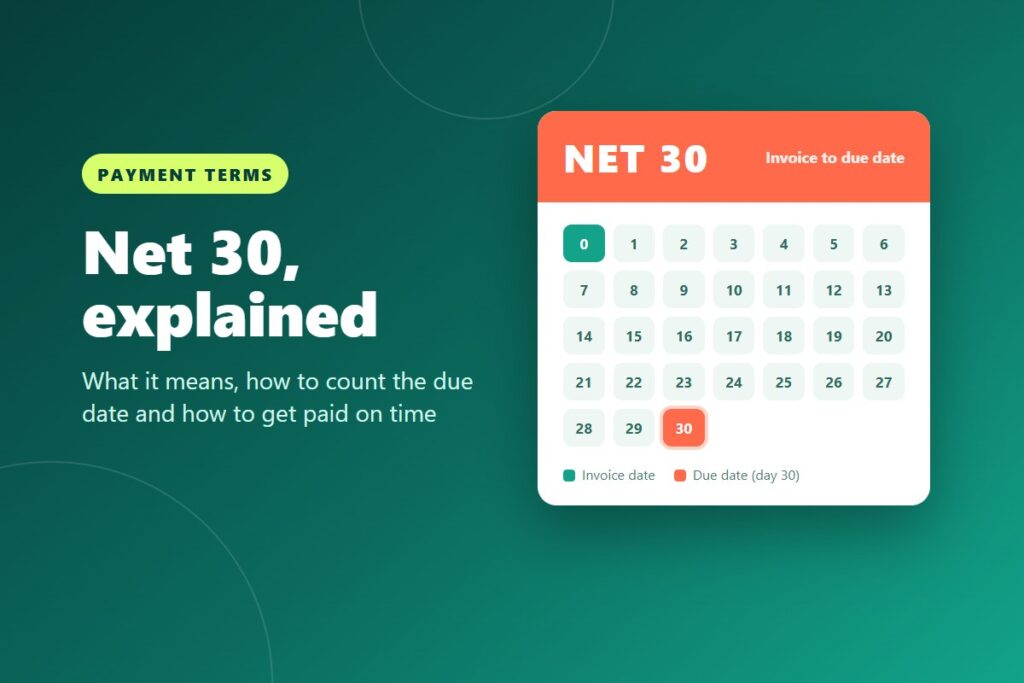
Net 30 means the full amount on an invoice is due within 30 days of the invoice date. An invoice dated 1 November with Net 30 terms is due on 1 December. The “net” refers to the full amount after any agreed discounts, and the 30 is counted in calendar days, not working days, unless your contract says otherwise. This guide explains how to calculate Net 30 due dates, how Net 30 compares with Net 15, Net 60 and 2/10 Net 30, what the law says about late payment and the exact wording to put on your invoices. To add payment terms and a due date automatically, use our free Invoice Generator.
Net 30 at a glance
| Question | Answer |
|---|---|
| What does Net 30 mean? | Pay the full invoice amount within 30 days |
| When does the 30 days start? | Usually the invoice date; some contracts use the date the invoice is received or the end of the month |
| Calendar or business days? | Calendar days, including weekends and holidays, unless agreed otherwise |
| Is paying on day 30 on time? | Yes. The invoice is late from day 31 |
| Who uses it? | Businesses billing other businesses: suppliers, agencies, contractors and freelancers |
One thing Net 30 is not: a “Net 30 account” or “Net 30 vendor”. Those phrases describe suppliers that give new businesses trade credit to help build a business credit history, a different topic from the payment terms on your own invoices.
From experience: For direct clients I prefer 50% upfront over plain Net 30: the deposit covers the risk, and the balance is due on delivery. When a payment has run late, a polite reminder with the invoice number, amount and due date has been enough to get it paid.
Hassan Saleem, founder of Technorious
How to calculate a Net 30 due date
Add 30 calendar days to the invoice date. Do not count the invoice date itself: an invoice dated 15 November is due on 15 December. Because months have different lengths, “the same date next month” is only a shortcut and is sometimes a day or two out, especially around February.
| Invoice date | Terms | Due date | Note |
|---|---|---|---|
| 1 Nov 2026 | Net 30 | Tue 1 Dec 2026 | November has 30 days, so the date matches |
| 15 Jan 2027 | Net 30 | Sun 14 Feb 2027 | January has 31 days, so it lands a day early; and it falls on a Sunday |
| 30 Jan 2027 | Net 30 | Mon 1 Mar 2027 | February is short, so the due date moves into March |
| 24 Nov 2026 | Net 30 | Thu 24 Dec 2026 | Due just before the holidays, when many accounts teams close |
| 10 Nov 2026 | Net 30 EOM | Wed 30 Dec 2026 | 30 days counted from the end of the invoice month (30 Nov) |
| 1 Dec 2026 | Net 15 | Wed 16 Dec 2026 | Shorter terms for smaller or newer clients |
What if the due date falls on a weekend or holiday?
Net 30 is still 30 calendar days, so the due date does not move by itself. In practice, many clients pay on the next business day, and bank transfers sent on a Friday may not arrive until Monday. If timing matters to you, say in your contract what happens when the due date is not a business day, and always print the exact due date on the invoice so no one has to count.
Net 15 vs Net 30 vs Net 60: which terms are common?
| Terms | Due | Typical use | For the seller |
|---|---|---|---|
| Due on receipt | Immediately | One-off jobs, new clients, small amounts | Fastest cash, but some companies cannot pay instantly |
| Net 7 | 7 days | Freelancers and small businesses | Quick payment, still gives the client a short window |
| Net 15 | 15 days | Freelancers, agencies, small clients | A good default for independent professionals |
| Net 30 | 30 days | The most common business-to-business term | Expected by many companies; slower cash flow |
| Net 45 / Net 60 | 45 or 60 days | Large companies, retailers, enterprise procurement | Long wait; worth pricing in or negotiating down |
| Net 90 | 90 days | Some large corporations and supply chains | Effectively a three-month loan to your client |
Longer terms are not just an inconvenience. If you invoice $5,000 a month on Net 60, roughly two months of work, about $10,000, is always waiting to be paid. On Net 15 that figure drops to about half a month’s billing. When a large client insists on Net 60, consider asking for a deposit or milestone payments, or price the delay into your rate. Our guide to setting a freelance hourly rate shows how to build costs like this into your price.
What does 2/10 Net 30 mean?
2/10 Net 30 means the client can take a 2% discount if they pay within 10 days; otherwise the full amount is due within 30 days. On a $1,650 invoice dated 10 November 2026, the client can pay $1,617 by 20 November, or the full $1,650 by 10 December.
The discount is more expensive than it looks. By paying 20 days early, the client earns 2% on the $1,617 it pays: 2 ÷ 98 = 2.04% for 20 days. Over a year that works out to roughly 37% (2/98 × 365/20). That makes it a great deal for the client, and an expensive way for a freelancer to get paid faster. Offer it only if quick cash is worth more to you than 2% of the invoice.
Other payment terms you may see
| Term | Meaning |
|---|---|
| EOM (end of month) | Payment is due at the end of the month the invoice is dated in |
| Net 30 EOM | Due 30 days after the end of the invoice month |
| CIA (cash in advance) | Paid in full before work starts |
| COD (cash on delivery) | Paid when the work or goods are delivered |
| 50% upfront | Half paid before work starts, the rest on completion |
| Milestone payments | Paid in stages as agreed parts of the project are delivered |
What the law says about payment terms and late payment
Payment terms are mainly a matter of contract, but several countries set limits and give suppliers rights when they are paid late.
- United Kingdom: if you agree a payment date, it must usually be within 30 days for public authorities or 60 days for business transactions; if no date is agreed, payment is late 30 days after the customer receives the invoice or the goods or service. Businesses can claim statutory interest of 8% plus the Bank of England base rate, and fixed compensation of £40 (debts up to £999.99), £70 (£1,000 to £9,999.99) or £100 (£10,000 or more). Source: GOV.UK: late commercial payments and claiming fixed-sum compensation.
- European Union: the Late Payment Directive limits business-to-business payment periods to 60 calendar days as a general rule, unless a longer period is expressly agreed and is not grossly unfair, and public authorities should normally pay within 30 days. Source: Directive 2011/7/EU.
- United States: there is no general federal rule for private businesses; late fees and interest are governed by your contract and by state law, which varies. Federal agencies are covered by the Prompt Payment Act, which requires them to pay interest penalties when they pay late. Source: U.S. Treasury: Prompt Payment.
If you work in another country, check its rules before adding interest or a late fee. A fee you never agreed with the client is hard to enforce anywhere.
Payment terms wording you can copy
Put the same terms in your contract or proposal and on every invoice. Replace the dates and amounts with your own.
- Net 30: “Payment terms: Net 30. Payment is due within 30 days of the invoice date, by 1 December 2026.”
- Net 15: “Payment terms: Net 15. Please pay by 16 December 2026.”
- Early payment discount: “Terms: 2/10 Net 30. Take a 2% discount if paid by 20 November 2026; otherwise the full amount is due by 10 December 2026.”
- Late fee (only if agreed and lawful where you work): “Payments received after the due date may incur a late fee of 1.5% per month on the outstanding balance.”
- UK statutory interest: “We reserve the right to claim interest and compensation under the Late Payment of Commercial Debts (Interest) Act 1998.”
- Deposit: “50% deposit due before work begins. The balance is due Net 15 from the final invoice.”
Our free Invoice Generator includes Due on receipt, Net 7, Net 15, Net 30, Net 45, Net 60 and Net 90, calculates the due date for you and has a one-click late fee note you can edit.
How to choose payment terms as a freelancer
- Start short. Net 7 or Net 15 is reasonable for most freelance work, and many small clients pay on receipt if you ask.
- Match the client’s process. Large companies often pay only in fixed payment runs on Net 30 or Net 60. Ask about their terms before you agree the price.
- Use deposits for new clients. A 30% to 50% deposit protects you and filters out clients who are not serious.
- Break big projects into milestones. Being paid in stages keeps cash coming in and limits what you can lose.
- Price in long terms. If a client wants Net 60 or Net 90, it is fair to charge more or ask for part of the fee upfront.
- Write it down. Put the terms in your proposal, contract and every invoice, with the actual due date.
How to get paid on time with Net 30 terms
Most invoices are paid late because of process, not bad intent: a missing purchase order, an invoice sent to the wrong person or a supplier form that was never filled in. Send the invoice the day the work is approved, include the client’s PO number, address it to the accounts team and print the due date. Send a friendly reminder three days before the due date and another the day after. Our guide on how to write a freelance invoice includes a filled-in example and a follow-up schedule for unpaid invoices.
If you are paid through a platform instead, the platform’s own schedule replaces your terms; for example, Fiverr and Upwork hold earnings for a clearance or review period before you can withdraw them. See Upwork fees for freelancers for how that works.
Set your terms on a professional invoice in a minute: choose Net 15 or Net 30, add a late fee note and download a PDF with our free Invoice Generator. No sign-up needed.
Frequently asked questions
What does Net 30 mean on an invoice?
It means the full invoice amount must be paid within 30 calendar days of the invoice date. An invoice dated 1 November is due by 1 December.
Does Net 30 include weekends?
Yes. Net 30 counts calendar days, including weekends and public holidays, unless your contract says business days.
Does Net 30 start from the invoice date or the delivery date?
Normally from the invoice date. Some contracts start the clock when the invoice is received or when the work is accepted, so check what you agreed and print the due date on the invoice.
Is Net 30 a good payment term for freelancers?
It is common but slow. Net 7 or Net 15 is usually better for freelancers. Accept Net 30 when a larger client requires it, ideally with a deposit or milestone payments.
What is the difference between Net 30 and Net 30 EOM?
Net 30 is due 30 days after the invoice date. Net 30 EOM is due 30 days after the end of the month the invoice is dated in, so an invoice dated 10 November is due on 30 December.
What does 2/10 Net 30 mean?
The client may deduct 2% if it pays within 10 days. Otherwise the full amount is due within 30 days.
Can I charge interest if a Net 30 invoice is paid late?
Only if your contract allows it and it is lawful where you work. In the UK, businesses can claim statutory interest of 8% plus the Bank of England base rate on late business payments.
Payment and late-payment rules vary by country and change over time. This article is general information, not legal or financial advice; check the official sources linked above or ask a qualified adviser.