


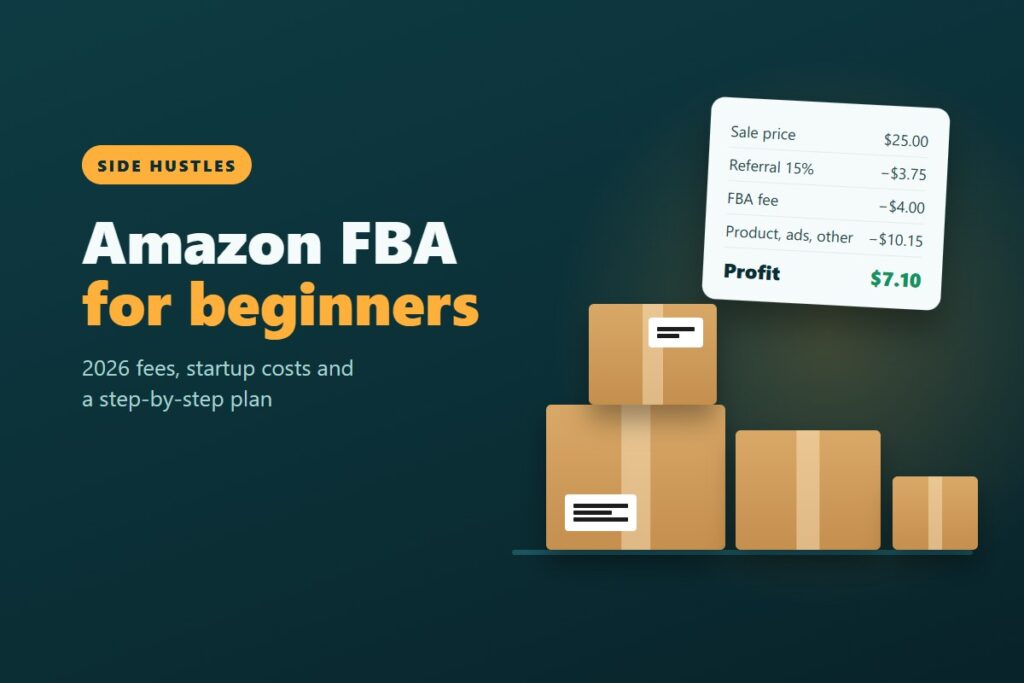
Amazon FBA (Fulfillment by Amazon) lets you sell products on Amazon while Amazon stores them, packs each order, ships it with Prime and handles returns. You pay for that with three main costs: a selling plan ($39.99 a month for Professional, or $0.99 per item sold on the Individual plan), a referral fee on every sale (15% in most categories) and an FBA fulfillment fee per unit that depends on the item’s size, weight and price. Most beginners need roughly $2,000 to $5,000 to launch a first private-label product properly, and a realistic profit is a few dollars per unit, not the “passive income” many videos promise. This guide shows how FBA works in 2026, every fee you will pay, a worked profit example and a step-by-step plan to launch.
Amazon FBA at a glance
| Question | Short answer |
|---|---|
| What you do | Find or make products, list them, prep and label them, and ship them to Amazon’s warehouses |
| What Amazon does | Stores your stock, picks, packs and ships orders (Prime eligible), and handles customer service and returns |
| Selling plan | Individual: $0.99 per item sold. Professional: $39.99 a month (needed for FBA at any real volume) |
| Referral fee | 15% in most categories, 8% in electronics and computers, with a $0.30 minimum per item |
| FBA fulfillment fee | A fee per unit based on size, weight and price. Check each product in Amazon’s free Revenue Calculator |
| Other FBA fees | Monthly storage, inbound placement, low-inventory-level, aged inventory and some returns fees |
| Typical startup budget | About $2,000 to $5,000 for a first private-label product |
| Time to first sale | Usually 6 to 12 weeks, mostly spent on product research, samples and shipping |
Fees checked in November 2026 against Amazon’s Sell on Amazon pricing page. Amazon changes fees most years, usually from mid-January.
How Amazon FBA works
With FBA you still own the business and the inventory. Amazon rents you warehouse space and its delivery network. The flow looks like this:
- You list a product in Seller Central and choose Amazon as the fulfillment channel.
- You prep and label the units, then create a shipment with Amazon’s Send to Amazon workflow.
- Amazon receives the stock, and your listing gets the Prime badge.
- A customer orders. Amazon picks, packs and ships it, and answers delivery questions.
- Amazon takes its fees from each sale and pays out the rest to your bank account, usually every two weeks.
The alternative is FBM (Fulfilled by Merchant), where you store and ship orders yourself. FBM has lower fees but more work per order, and your listings usually lose the Prime badge. Many sellers start with FBM to test a product, then move it to FBA once it sells steadily.
What changed for FBA sellers in 2026
- Amazon no longer preps or labels for you. From January 1, 2026, Amazon stopped offering FNSKU labeling and poly-bagging for US FBA shipments (Amazon’s announcement). You must do it yourself or pay a prep center, and badly prepped shipments are not eligible for lost or damaged inventory reimbursement.
- Fulfillment fees went up slightly. From January 15, 2026, FBA fees rose by an average of $0.08 per unit, and Amazon said there would be no new FBA fee types in 2026.
- Referral fees stayed the same. The 15% rate for most categories did not change.
Amazon FBA fees in 2026, explained
1. Selling plan
The Individual plan costs $0.99 per item sold with no monthly fee. The Professional plan costs $39.99 a month with no per-item fee. Above about 40 sales a month, Professional is cheaper, and it unlocks advertising, the Buy Box on more listings and Brand Registry tools, so almost every serious FBA seller uses it.
2. Referral fee
Amazon takes a percentage of the total sale price (including shipping and gift wrap) or a minimum amount, whichever is greater. Common rates:
| Category | Referral fee |
|---|---|
| Home and Kitchen, Toys and Games, Sports and Outdoors, Office Products, Tools, most others | 15% |
| Consumer Electronics, Computers | 8% |
| Automotive and Powersports, Business and Industrial Supplies | 12% |
| Beauty, Baby Products (item price $10 or less) | 8%, then 15% above $10 |
| Clothing and Accessories | 5% up to $15, 10% from $15 to $20, 17% above $20 |
| Books, music, video and software | 15% plus a $1.80 closing fee per item |
Most categories also have a $0.30 minimum referral fee. Full list on Amazon’s pricing page.
3. FBA fulfillment fee
This is the per-unit fee for picking, packing, shipping and handling returns. It depends on the product’s size tier (small standard, large standard, large bulky and so on), its shipping weight and its price band, with lower rates for items priced under $10. Small, light products cost a few dollars per unit to fulfill, while bulky or heavy items can cost well over $10. Because the tables have dozens of rows, the reliable way to get the exact fee for your product is Amazon’s free FBA Revenue Calculator: search a similar product, enter your price and cost, and it shows the fulfillment and referral fees.
4. Storage and inventory fees
- Monthly storage fee: charged per cubic foot of space your stock uses. The rate is about three times higher from October to December, so don’t send more holiday stock than you can sell.
- Aged inventory surcharge: an extra storage fee on units that sit in Amazon’s warehouses for many months. Send smaller, more frequent shipments instead of a year’s supply.
- Inbound placement fee: charged per unit when you ship to fewer locations. If you accept Amazon’s suggested split across several warehouses, this fee is lower or zero.
- Low-inventory-level fee: charged when your stock is too low compared with your sales. Keep a few weeks of supply in stock.
- Returns processing fee: charged on some products in categories with high return rates.
Worked example: what you keep from a $25 product
Say you sell a 12-ounce kitchen gadget for $25. The fulfillment fee below is an illustrative figure for a small item at this price. Use the Revenue Calculator for your real product.
| Line | Per unit |
|---|---|
| Sale price | $25.00 |
| Referral fee (15%) | −$3.75 |
| FBA fulfillment fee (illustrative) | −$4.00 |
| Storage (share per unit) | −$0.15 |
| Product cost, landed at Amazon (incl. freight, prep and labels) | −$7.00 |
| Advertising (about 10% of sales) | −$2.50 |
| Returns and damaged units (allowance) | −$0.50 |
| Profit before tax | $7.10 (28% margin) |
Amazon takes about $7.90 of the $25 here, and advertising another $2.50. Selling 300 units a month would earn about $2,130 before the $39.99 plan fee and income tax. If the same product cost you $11 instead of $7, the margin would drop to 12%, and one price war could wipe it out. A common rule: aim for a landed cost of no more than 25% to 30% of the selling price.
How much money you need to start
| Cost | Typical range |
|---|---|
| Professional plan (first 2 to 3 months) | $80 to $120 |
| Product samples from 2 to 3 suppliers | $100 to $300 |
| First inventory order (300 to 500 units) | $1,000 to $3,000 |
| Freight to Amazon, prep and labels | $200 to $600 |
| Product photos and listing design | $100 to $500 |
| Barcodes (UPC/GTIN) and trademark (optional at first) | $30 to $400+ |
| Launch advertising (first month) | $300 to $600 |
| Total | About $2,000 to $5,000 |
Typical ranges for a small, light private-label product. Wholesale and arbitrage can start smaller, from a few hundred dollars.
4 ways to sell with FBA
- Private label: you sell a product under your own brand, usually made by a manufacturer. It has the highest potential, but it is also the most expensive and the riskiest.
- Wholesale: you buy existing brands in bulk from authorized distributors and resell them. Margins are lower, and you need permission from the brand.
- Retail or online arbitrage: you buy discounted products in stores or online and resell them on Amazon. It is cheap to start and works for learning, but it is hard to scale, and some brands are restricted.
- Handmade: you sell your own crafts through Amazon Handmade with FBA. If this is you, compare it with selling on Etsy first.
How to start Amazon FBA: step by step
- Pick a model and a product. Look for products that sell steadily all year, weigh under 2 pounds, sell for $20 to $50, aren’t fragile, and have top listings with fewer than a few hundred reviews. Avoid restricted categories such as supplements, topicals and electronics with batteries for your first product.
- Check the numbers before you buy. Run the product through the FBA Revenue Calculator, add landed cost, advertising and returns, and only continue if the profit is at least $5 per unit and the margin is above 20%.
- Open a Professional seller account. You need a government ID, a bank account, a credit card, a phone number and your tax information. Amazon verifies your identity before you can sell.
- Order samples and choose a supplier. Compare 2 to 3 suppliers on quality, price, minimum order and production time. Ask for a pre-shipment inspection on your first order.
- Create your listing. Write a clear title with the main keyword, five benefit-focused bullet points and a description, and add at least 6 good photos. Register your brand in Brand Registry once you have a trademark application.
- Prep, label and ship. Label each unit with its FNSKU barcode, bag or box it to Amazon’s prep rules (or use a prep center), then create the shipment in Send to Amazon.
- Launch and get your first reviews. Run Sponsored Products ads on your main keywords, and enroll in Amazon Vine if you are eligible. Never buy reviews or offer free products in exchange for reviews, which gets accounts suspended.
- Track your profit and restock. Check your real fees in your payments reports every week, reorder before you run low, and cut ads that don’t pay for themselves.
Is Amazon FBA still worth it in 2026?
FBA can work, but it is a real business with inventory risk, not a side hustle you can run on a few hours a week from day one. It is a good fit if you have $2,000 or more you can afford to lose, can wait 3 to 6 months for profit, and enjoy research and numbers. It is a poor fit if you need income quickly or can’t risk money on stock. In that case, start with something that has no inventory, such as digital products, Kindle publishing or one of these side hustles you can start with no money. Not sure which suits you? Our free Side Hustle Finder matches ideas to your skills, budget and time.
Taxes on Amazon FBA income
In the US, FBA profit is self-employment income. You pay income tax plus 15.3% self-employment tax on your net profit, whether or not you receive a Form 1099-K. Amazon sends a 1099-K once your sales pass the IRS reporting threshold (see the IRS page). Keep records of inventory, freight, fees and ads, because these reduce your taxable profit. Our free Self-Employment Tax Calculator shows how much to set aside. Sellers outside the US, including Pakistan, can sell on Amazon.com too. You complete Amazon’s tax interview (usually Form W-8BEN), receive payouts through a supported bank or payment service, and pay tax in your own country.
Common beginner mistakes
- Choosing a product because it is popular, not because the numbers work after fees and ads.
- Ordering too much stock at first, then paying storage and aged inventory fees on it.
- Forgetting that Amazon no longer preps units, and having shipments rejected or unprotected.
- Copying a big brand’s design or logo, which leads to listing removals and account trouble.
- Ignoring advertising costs, which often take 10% to 20% of sales during launch.
Frequently asked questions
How much does Amazon FBA cost per month?
The Professional plan costs $39.99 a month. On top of that you pay a referral fee (15% in most categories) and an FBA fulfillment fee on each unit sold, plus monthly storage for the space your stock uses.
How much money do you need to start Amazon FBA?
Most beginners need about $2,000 to $5,000 to launch a first private-label product, including samples, a first order of 300 to 500 units, freight, photos and launch ads. Arbitrage and small wholesale orders can start with a few hundred dollars.
How much can a beginner make with Amazon FBA?
A typical profitable product earns a few dollars per unit after all fees and ads, often a 15% to 30% margin. Many beginners lose money on their first product, so start small and check your real fees weekly.
Does Amazon still prep and label FBA products?
No. Since January 1, 2026, Amazon no longer offers prep and item labeling for US FBA shipments. Sellers must label and prep units themselves or use a third-party prep center.
Can I do Amazon FBA from Pakistan or outside the US?
Yes. Sellers from many countries, including Pakistan, can register on Amazon.com with a valid ID, an international credit card and a bank account or payment service that can receive payouts. You still need to get your products to a US Amazon warehouse, usually through a freight forwarder.
Amazon’s fees, rules and restricted categories change often and can differ by account. This article is general information, not financial or tax advice. Always confirm current fees in Seller Central before you order inventory.




Spot on with this write-up, I honestly believe this web site needs a lot more attention. I’ll probably be back again to see more, thanks for the info!
Thank you for your kind words!
Hello there! This post couldn’t be written any better! Looking at this article reminds me of my previous roommate! He continually kept talking about this. I most certainly will send this article to him. Fairly certain he’ll have a very good read. I appreciate you for sharing!
We are glad that you liked it.