

By Technorious
On March 29, explosions were reported in Tehran while missiles were launched from Yemen toward Israel. Around the same time, U.S. positions in the region came under renewed drone threats during the ongoing war.
Multiple fronts. Multiple actors. One pattern.
This is no longer a conventional war. It is a system—fast, distributed, and increasingly automated.
The War Expanded Overnight
What changed in the last 48 hours is not just intensity—it’s geography.
Iran-backed Houthis in Yemen have now directly entered the conflict, launching missiles toward Israel for the first time in this war. (The Washington Post)
This matters for one reason:
the battlefield is no longer regional—it is networked.
- Iran strikes Israel
- Israel strikes Iran and Lebanon
- U.S. bases are targeted across the region
This is not escalation.
This is integration.
The Speed Problem No One Can Control
Recent operations show a clear pattern: speed has become the defining factor.
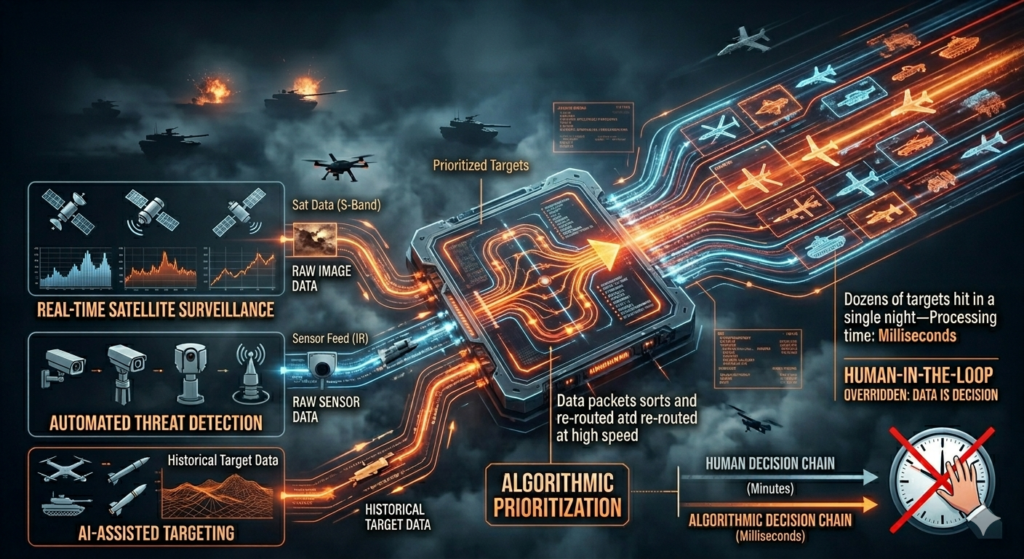
Large-scale strike packages—dozens of targets hit in a single night—are now possible because of:
- AI-assisted targeting
- real-time satellite surveillance
- automated threat detection
- algorithmic prioritization
The time between:
detect → decide → strike
has collapsed.
And that changes the nature of war.
Too Fast to Think, Too Fast to Stop
Here’s the uncomfortable reality:
When decisions move faster than human response time, control becomes fragile.
Today:
- Drone swarms are launched in waves
- Defense systems auto-track and intercept
- Targets are identified in seconds
Commanders are no longer approving every strike individually.
Instead, they are increasingly approving systems that execute those decisions.
That shift—from human-led action to system-trusted execution—is where risk begins.
A War That Doesn’t Need Borders
The latest developments confirm a deeper shift.
This conflict is now active across:
- Iran
- Israel
- Lebanon
- Syria
- Yemen
- Gulf regions
Iran has also previously demonstrated its ability to strike across multiple countries simultaneously, targeting U.S. bases and regional infrastructure. (FDD)
At the same time:
- shipping routes are disrupted
- energy markets are unstable
- regional airspace has been affected
This is no longer a contained conflict.
It is a system-wide disruption.
Why Technology Is Fueling, Not Preventing, War
For years, advanced military technology was expected to make war more controlled and precise.
What we are seeing suggests the opposite.
Technology is:
- lowering the cost of attack (cheap drones)
- increasing speed of retaliation
- enabling multi-front coordination
- reducing time for diplomacy
The result is not stability.
The result is constant escalation pressure.
The Illusion of Advantage
On paper, the United States and Israel have achieved significant tactical gains:
- missile sites destroyed
- infrastructure targeted
- launchers neutralized
But the reality is more complicated.
Recent intelligence indicates that only about one-third of Iran’s missile arsenal has been destroyed, meaning a substantial capability still remains. (The Guardian)
At the same time, Iran has demonstrated several critical strengths:
- Its missiles have successfully penetrated advanced air defense systems, causing damage and injuries inside Israel (The Washington Post)
- It has maintained continuous strike capability, launching missiles and drones even after weeks of sustained attacks
- Its arsenal is distributed and hidden, often in underground networks, making it difficult to fully eliminate
- It has expanded the conflict through regional proxies, opening new fronts like Yemen
In total, Iran has already launched hundreds of missiles and thousands of drones since the war began. (Wikipedia)
This creates a strategic contradiction:
Despite technological superiority,
the war continues to expand—and the threat persists.
Technology increases power.
But it also increases resilience on both sides.
The Most Dangerous Shift: War as a Continuous System
What we are witnessing is not a sequence of events.
It is a continuous operational loop:
- Detection (satellites, sensors)
- Processing (AI systems)
- Decision (compressed human + machine input)
- Action (drones, missiles, cyber operations)
- Reaction (instant retaliation)
Then it repeats.
Faster each time.
What Happens Next
Three developments suggest where this is heading:
1. More Fronts Will Open
Proxy groups are entering the conflict. Yemen is likely not the last.
2. The Conflict Will Stretch Longer
Statements from U.S. leadership suggest the war is expected to continue rather than end quickly. (New York Post)
3. Pressure Will Shift to Infrastructure
Energy routes, shipping lanes, and economic systems will become increasingly central targets.
Final Observation
This war is not being slowed down by technology.
It is being accelerated by it.
The machines are not replacing humans.
They are outpacing them.
And for the first time in modern conflict, the biggest risk may not be who fires the next shot—
but whether anyone still has enough time to stop it.
Coming Next: The Invisible War
Cyber attacks, misinformation, and the battle for reality itself.