

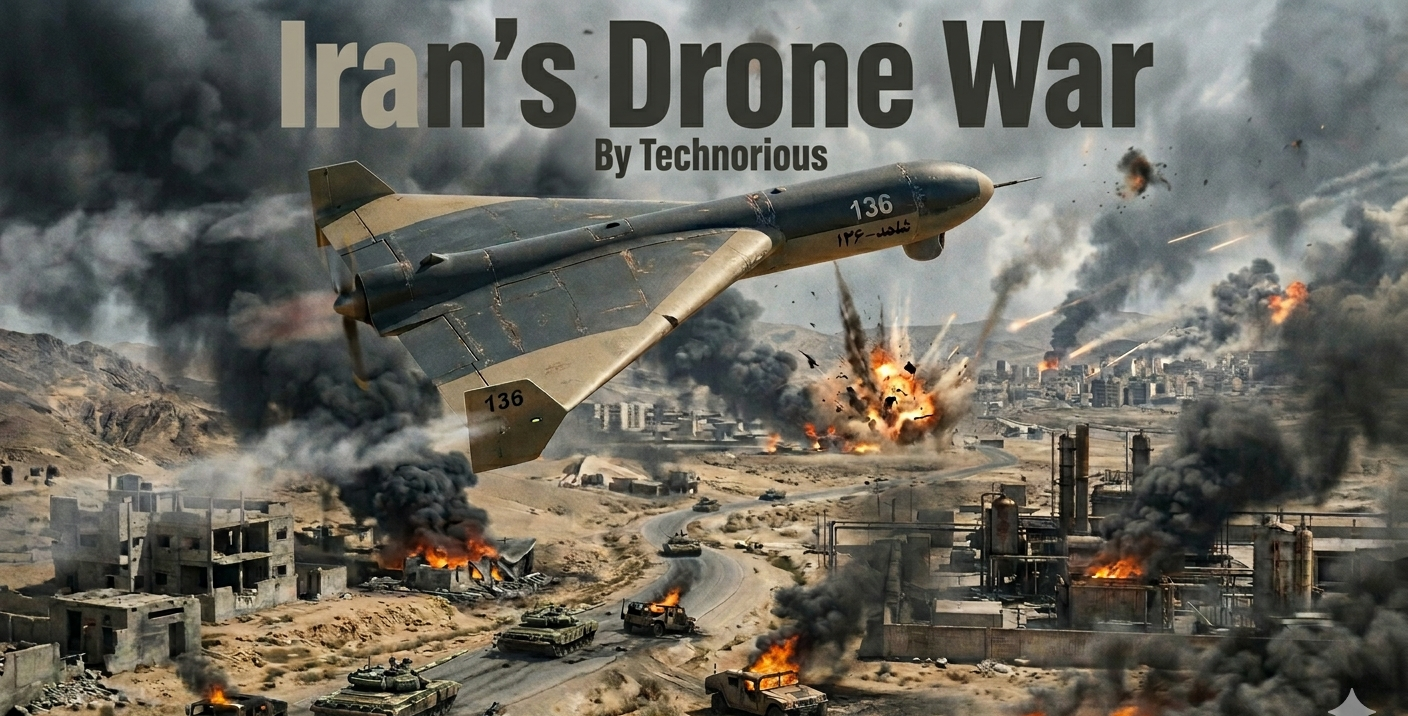
By Technorious
The night sky over the Middle East is no longer defined by silence.
It flashes.
Air defense systems fire in bursts. Interceptors chase incoming targets. Explosions ripple across cities and strategic sites. But what’s approaching is not a fleet of fighter jets.
It is something else.
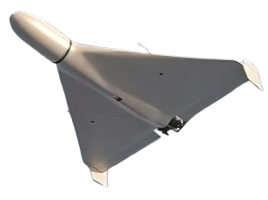
Waves of drones and missiles—cheap, coordinated, and relentless.
In 2026, the Iran–Israel–US conflict has entered a new phase. And at the center of it is a technological shift that is redefining modern warfare.
Iran’s Drone War: Quantity as a Weapon
For decades, military power was measured by sophistication—stealth aircraft, precision-guided munitions, advanced defense systems.
Iran is challenging that model.
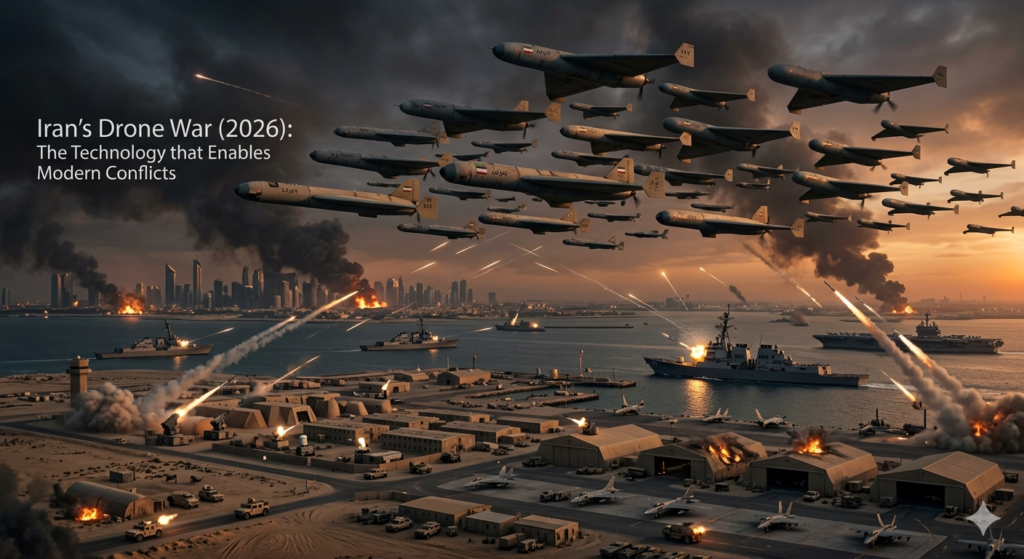
Instead of relying on a small number of high-end systems, Iran’s strategy focuses on scale. Large numbers of drones are launched in coordinated waves, designed not necessarily to evade defenses—but to overwhelm them.
Recent reports indicate that in a single wave, more than 100 drones were launched toward Gulf targets, alongside ballistic missiles. These attacks triggered air defense responses across multiple countries and disrupted regional stability.
This is the core of Iran’s drone warfare strategy:
- Deploy large volumes of low-cost drones
- Attack from multiple directions simultaneously
- Force defenses into resource exhaustion
It is not about perfection.
It is about pressure.
How Swarm Drones Are Changing Warfare
Iran’s use of swarm drones represents one of the most important developments in modern military technology.
Unlike traditional attacks, swarm operations involve:
- Dozens or hundreds of drones moving in coordinated patterns
- Simultaneous targeting of multiple locations
- Continuous waves that stretch defensive systems
Even advanced air defense systems face a dilemma.
Each interceptor missile used to destroy a drone can cost significantly more than the drone itself. Over time, this creates an economic imbalance that favors the attacker.
In simple terms:
It is cheaper to attack than to defend.
This single shift is forcing militaries around the world to rethink their defense strategies.
Iran’s Missile Technology Still Holds
Alongside drones, Iran continues to rely on a wide range of missile systems.
Despite sustained strikes against its infrastructure, recent intelligence assessments suggest that a significant portion of Iran’s missile arsenal remains intact.
These missiles have:
- Reached targets across long distances
- Forced repeated activation of defense systems
- Maintained consistent pressure on adversaries
More importantly, Iran has demonstrated the ability to launch missiles continuously over weeks, rather than relying on isolated strikes.
This persistence is critical.
Because in modern warfare, endurance can matter more than initial impact.
Underground Systems and Mobile Launchers
One of the reasons Iran’s military capabilities remain operational is how they are structured.
Missile systems are not centralized in easily targetable locations. Instead, they are:
- Stored in underground tunnel networks
- Mounted on mobile launch platforms
- Frequently relocated between strikes
This makes them difficult to track and destroy completely.
Even when a launch site is identified and hit, the system as a whole survives.
This is not accidental.
It is a design built for survival under constant attack.
Economic Targets: Energy and Infrastructure
Iran’s attacks are not limited to military objectives.
Energy infrastructure and shipping routes have also come under pressure.
The Strait of Hormuz—one of the world’s most critical oil transit points—has seen disruptions, affecting global energy markets. Oil prices have responded quickly to instability in the region.
This highlights another dimension of modern warfare:
Economic disruption as a strategic objective.
By targeting infrastructure, the impact of conflict extends beyond borders and into global systems.
Why Iran’s Strategy Is Working
Despite facing technologically superior adversaries, Iran has managed to sustain pressure and expand the conflict.
This is not because it has better technology.
It is because it is using technology differently.
Iran’s system is:
- Distributed → difficult to eliminate completely
- Scalable → capable of launching large volumes of attacks
- Cost-effective → relies on relatively inexpensive systems
- Persistent → maintains continuous operational pressure
Traditional military strategies are built around eliminating key assets.
But this model does not rely on a few critical assets.
It relies on many replaceable ones.
The Shift in Modern Warfare Technology
What we are witnessing in 2026 is a shift in how warfare is conducted.
The focus is moving away from:
- High-cost, high-precision dominance
And toward:
- High-volume, coordinated pressure
This does not replace advanced systems.
But it changes how they are challenged.
Even the most sophisticated defenses can struggle when faced with:
- Continuous waves
- Multi-directional attacks
- Long-duration engagement
The Bigger Picture: A New Kind of Conflict
The Iran–Israel–US conflict is not just another regional war.
It is a demonstration of how modern warfare technology is evolving.
Key trends emerging from this conflict include:
- The rise of drone warfare at scale
- The increasing importance of missile endurance
- The expansion of proxy-driven conflict networks
- The targeting of economic infrastructure
Together, these elements are reshaping how power is projected and resisted.
Final Analysis
Iran’s approach does not rely on being the most advanced military power.
It relies on being the most adaptable and persistent.
By combining drones, missiles, and decentralized operations, it has created a system that is:
- difficult to stop
- costly to defend against
- capable of sustained pressure
This does not guarantee victory.
But it changes the rules.
And in 2026, those rules are already being rewritten.
Coming Next: The Algorithm War
How artificial intelligence and automated systems are accelerating modern conflict beyond human control.